Exit

Author Archives: New Method Plating Company, Inc.

  1. The Ultimate Guide to Aerospace Metal Finishing

    Comments Off on The Ultimate Guide to Aerospace Metal Finishing

    In aerospace applications, materials and parts are manufactured to strict requirements and specifications so they are durable and reliable. Metal finishing is an important aspect of manufacturing because it prepares materials for operating conditions, wear and tear, and functional requirements while in use.

    At New Method Plating, we are a NADCAP-accredited and ISO 9001:2015- and AS 9100-certified company that specializes in precision electroplating with cadmium, nickel, zinc, chrome, and copper. Learn more about metal finishing for aerospace components, the plating techniques and materials we use, and the importance of NADCAP and AS 9001 compliance.

    The Significance of Aerospace Plating

    Plating serves multiple functions from enhancing corrosion resistance or conductivity to providing wear protection, and more. Unlike many standard industrial applications, aerospace component finishing requires higher levels of precision as well as compliance with specifications for performance and safety. These include:

    • Corrosion protection: Including in harsh environments (e.g., moisture, chemicals, and temperature extremes).
    • Adhesion and conductivity: For electrical and avionics systems.
    • Improved compatibility: Especially with certain base metals and composite materials.
    • Thickness tolerances: For safety and performance in mission-critical parts.
    • Traceability and quality controls: To meet strict standards for OEMs and government contractors.

    Cadmium Plating for Aerospace Components

    Cadmium plating is common in aerospace manufacturing. This material provides sacrificial corrosion protection and strong lubricity, making it ideal for high-torque threaded parts and fasteners. It also prevents galvanic corrosion in dissimilar metal assemblies to extend component life.

    For any of the following design requirements, cadmium plating is often the ideal solution:

    • Low electrical contact resistance.
    • Effective protection against thread seizing.
    • Excellent corrosion resistance in marine and high-humidity conditions.
    • Good solderability and bonding characteristics.

    Chem Film Applications in Aerospace

    Chem film, or chromate conversion coating, is used to protect aluminum components. By creating a passive film on the surface, chem films help resist corrosion while preserving electrical conductivity and paint adhesion. This is especially important on aircraft skin panels and electronic housings.

    A quality chem film also facilitates:

    • Conductive finish for electronic enclosures.
    • Corrosion protection on aluminum alloys.
    • Primer base for painted surfaces.
    • Repairable surfaces for in-service aircraft maintenance.

    Nickel Plating in Aerospace Manufacturing

    For components requiring high wear resistance and dimensional accuracy, nickel plating provides a hard, uniform coating. Aerospace engineers often specify electroless nickel for turbine blades, actuators, and hydraulic system components.

    Nickel plating offers an excellent balance of precision, durability, and these additional factors:

    • Uniform deposition on complex geometries.
    • High hardness and abrasion resistance.
    • Good chemical resistance in hydraulic systems.
    • Compatible with various base metals, including steel and aluminum.

    Zinc Plating for Aerospace Parts

    While not as widespread as cadmium plating, zinc plating is often found in non-flight-critical aerospace parts. Zinc protects steel substrates from corrosion and is well-suited to ground support and interior applications, where cadmium restrictions apply.

    Zinc plating also provides:

    • Corrosion protection for steel housings and brackets.
    • A safer alternative to cadmium for non-critical assemblies.
    • Higher cost efficiency for high-volume components.
    • Potential for enhancement with chromate topcoats to increase durability.

    Understanding AS 9100 and Its Role in Aerospace Metal Finishing

    AS 9100 is an international quality management standard for aviation, space, and defense manufacturing. Certification to this standard ensures that strict process controls are implemented and followed for risk management and continuous improvement. Core requirements include:

    • Meeting OEM and Tier 1 contractor requirements.
    • Maintaining full traceability of every part processed.
    • Ensuring process repeatability and documentation.
    • Supporting auditing, compliance, and customer satisfaction.

    The Importance of NADCAP Accreditation in Aerospace Finishing

    NADCAP accreditation is the gold standard for aerospace component finishing. Managed by the Performance Review Institute, it verifies that special process providers, including electroplating companies, meet industry-specific technical requirements. These requirements include:

    • Validating technical capability and process control.
    • Reduced supplier risks in aerospace programs.
    • Alignment with prime contractor specifications.
    • A commitment to continuous quality improvement.

    Trust New Method Plating for Precision Aerospace Metal Finishing

    From cadmium and chem film to nickel and zinc plating, New Method Plating provides expert finishing backed by extensive industry knowledge. We are AS 9100-certified and hold NADCAP accreditation.

    Contact us to learn more about our capabilities, or request a quote to discuss your next aerospace plating project.
  2. Understanding the Vapor Degreasing Process

    Comments Off on Understanding the Vapor Degreasing Process

    Vapor degreasing helps clean certain surfaces by using solvent vapors to dissolve greases, oils, and other contaminants. The thorough cleaning this technique provides subsequently prepares the designated workpiece for final finishing processes. This also makes it popular in industries where cleanliness and sanitation are critical requirements, including automotive, aerospace, and medical applications. With a better understanding of this industrial metal cleaning technique and its advantages over other cleaning methods, you can determine whether vapor degreasing is right for your application.

    How Does Vapor Degreasing Work?

    The vapor degreasing process works based on the principle of condensation cleaning, entailing the following steps:

    1. Solvent Boiling

    A sump heats a particular type of solvent to convert it into vapors for cleaning. The large amounts of vapor subsequently generate a vapor zone suitable for cleaning various parts. The vapor zone is maintained using condenser coils or a water jacket, which traps the vapors to keep them from escaping the system.

    2. Condensation Cleaning

    The cleaning process results from condensation that forms on the part’s surface within the vapor zone. This thin liquid film then begins to dissolve greases, oils, and other elements on the part’s surface. The exact cleaning conditions may differ depending on the weight and specific heat requirements of the given application.

    3. Drainage and Drying

    Once cleaning is complete, the contaminated liquid begins to drip down into the sump below, carrying the contaminants with it. The end result is a dry, thoroughly cleaned part that is ready to undergo any additional processing.

    This closed-loop system effectively cleans surfaces while enabling the recycling of solvents for future use, making the degreasing process both reliable and sustainable.

    Benefits of Vapor Degreasing

    Vapor degreasing comes with multiple advantages that set it apart from other processes, such as:

    • Enhanced cleaning efficiency. Vapor degreasers eliminate many contaminants from metal surfaces, including some of the thickest greases, using an efficient, closed-loop process.
    • Non-abrasive cleaning. Vapor degreasing is also gentler than more abrasive mechanical techniques, helping maintain each part’s structural integrity, regardless of complexity.
    • Speed and consistency. The process is highly automated to optimize productivity and uniformity while reducing the need for manual cleaning tasks.
    • Eco-friendliness and cost-effectiveness. This technique facilitates the recovery and reuse of solvents, saving you money on operational expenses while minimizing waste.
    • Material versatility. Vapor degreasing is a versatile process that can clean many types of parts, including metal workpieces and those comprising certain polymers.

    Quality Vapor Degreasing by New Method Plating

    If you need a reliable cleaning technique for your parts, the vapor degreasing process is one of the most effective, efficient, and sustainable options available. At New Method Plating, we provide this solution for precision parts cleaning, helping you clean various parts with some of the latest technology. In addition to vapor degreasing, you’ll find many types of solutions with New Method Plating, including metal plating services, passivation, sandblasting, and chem film coatings. Whatever your needs, we’re here to meet them with the right solution based on your unique application requirements.

    Request a quote today to discuss a potential project with our team of experts.

  3. Demystifying Environmental Concerns: Responsible Use of Cadmium Plating

    Comments Off on Demystifying Environmental Concerns: Responsible Use of Cadmium Plating
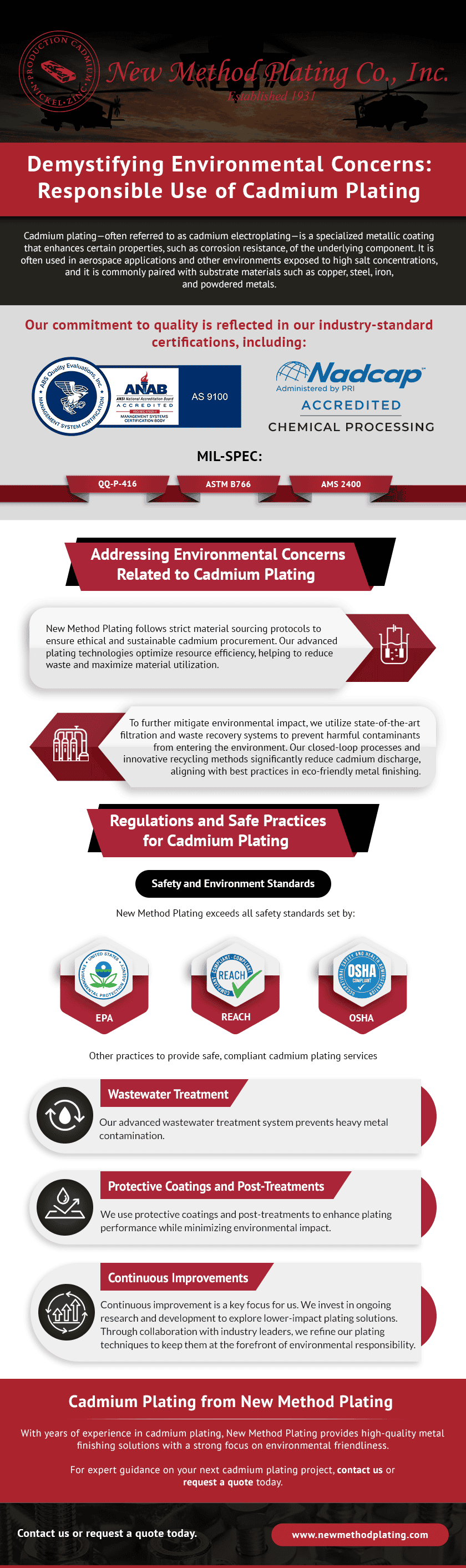
    Click to ExpandDemystifying Environmental Concerns: Responsible Use of Cadmium Plating

    Cadmium plating—often referred to as cadmium electroplating—is a specialized metallic coating that enhances certain properties, such as corrosion resistance, of the underlying component. It is often used in aerospace applications and other environments exposed to high salt concentrations, and it is commonly paired with substrate materials such as copper, steel, iron, and powdered metals.

    As a family-owned business, New Method Plating has built a strong reputation in metal finishing. While cadmium plating offers numerous benefits, it also raises some environmental concerns. New Method Plating addresses these issues through advanced waste management, strict compliance, and sustainable innovations, ensuring our cadmium-plated components meet high performance and environmental standards.

    Addressing Environmental Concerns Related to Cadmium Plating

    Environmental responsibility is a core priority at New Method Plating. We implement rigorous sustainability practices to minimize the ecological impact of cad plating while maintaining superior product quality.

    New Method Plating follows strict material sourcing protocols to ensure ethical and sustainable cadmium procurement. Our advanced plating technologies optimize resource efficiency, helping to reduce waste and maximize material utilization.

    To further mitigate environmental impact, we utilize state-of-the-art filtration and waste recovery systems to prevent harmful contaminants from entering the environment. Our closed-loop processes and innovative recycling methods significantly reduce cadmium discharge, aligning with best practices in eco-friendly metal finishing.

    Regulations and Safe Practices for Cadmium Plating

    New Method Plating complies with stringent industry regulations, helping us deliver superior plating solutions while safeguarding the environment. We meet or exceed all standards set by the EPA, REACH, and OSHA to ensure our cad plating process meets the highest safety and environmental standards. Other practices we’ve implemented to provide safe, compliant cadmium plating services include:

    • Wastewater Treatment. Our advanced wastewater treatment system prevents heavy metal contamination.
    • Protective Coatings and Post-Treatments. We use protective coatings and post-treatments to enhance plating performance while minimizing environmental impact.
    • Continuous Improvements. Continuous improvement is a key focus for us. We invest in ongoing research and development to explore lower-impact plating solutions. Through collaboration with industry leaders, we refine our plating techniques to keep them at the forefront of environmental responsibility.

    Cadmium Plating from New Method Plating

    With years of experience in cadmium plating, New Method Plating provides high-quality metal finishing solutions with a strong focus on environmental friendliness. Our state-of-the-art processes, regulatory compliance, and commitment to sustainable practices make us a trusted partner for industries requiring superior plating solutions. For expert guidance on your next cadmium plating project, contact us or request a quote today.

  4. Understanding the Role of Cadmium Plating in Aerospace and Military Applications

    Comments Off on Understanding the Role of Cadmium Plating in Aerospace and Military Applications

    Cadmium plating plays a crucial role in aerospace and military operations, ensuring the reliability and longevity of critical components. New Method Plating specializes in cadmium plating services, providing the precision and dependability that aerospace and military plating applications require. Learn more about cadmium plating and how it contributes to the safety and longevity of essential components in these industries.


    What Is Cadmium Plating?

    Cadmium is a soft, silvery metal that resists corrosion and chemical damage. Manufacturers can add cadmium plating to aluminum, brass, copper, iron, or steel parts to create a smooth, uniform layer on surfaces. Some of the positive characteristics cadmium plating offers include:

    • Good bonding with other metals
    • Lubricity
    • Ductility
    • Chemical and corrosion resistance
    • Solderability

    These qualities make cadmium plating an ideal coating for metal bolts and other fasteners, military parachute buckles, aerospace galvanic couplers, and more. 

    The Role of Cadmium Plating in Aerospace and Military Applications

    Cadmium plating is extensively used in aerospace and military applications due to its protective properties. It can make metal components last longer in harsh environments, reducing the need for replacement and repairs that can complicate missions. Take a closer look at how cadmium plating can make components more functional and effective over the long term.

    Corrosion Protection

    Cadmium naturally resists corrosion, even in marine environments with exposure to salt water. Cadmium plating creates a corrosion-resistant shield around metal parts so the chemicals can’t reach the vulnerable metal underneath. This protects defense and aerospace components from chemicals, reducing the need for frequent replacements or unscheduled downtime. 

    Wear Resistance

    Cadmium plating also resists physical wear and tear. It allows gears and bearings to handle repeated movement and heavy loads without showing deformation. In aerospace applications requiring precision, cadmium plating’s high wear resistance also helps maintain components’ structural integrity. 

    Electrical Conductivity

    Electrical systems and components in demanding aerospace environments can face exposure to extreme temperatures during operation. High temperatures can cause these to overheat and malfunction. Using cadmium plating on electrical components enables better electrical functionality and can improve system efficiency. 

    Low Toxicity

    Cadmium can be unsafe in large volumes or with long-term exposure. However, using cadmium plating offers relatively lower toxicity risks. This option allows aerospace manufacturers to produce safer goods while still harnessing the positive effects of cadmium.

    Lightweight Quality

    In the aerospace industry, minimizing weight requirements is key to many designs. Manufacturers can produce lighter-weight components by plating lighter metals with cadmium, reducing the total weight of assemblies and vehicles. This lighter-weight solution also increases speed and maneuverability.

    Efficiency

    Cadmium plating improves the reliability of electrical systems. This is crucial to maintaining safety and minimizing downtime. It also prevents system or component issues for end users.

    High-Quality Cadmium Plating From New Method Plating

    New Method Plating Co., Inc. provides high-quality cadmium plating services, producing high-performance surface coatings that meet the unique requirements of aerospace and military applications. Customers in these fields can benefit from improved wear protection, corrosion resistance, and more when they choose to work with us for their plating needs. We maintain ISO 9001 and AS9100 certifications, and our processes comply with Mil-Spec and other industry standards as part of our quality assurance processes. 

    Contact us today to learn more or request a quote to start your order. 

© 2026 New Method Plating Company, Inc. All Rights Reserved | Site Created by Thomas Marketing Services