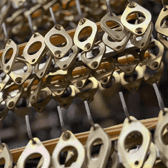
ASTM Zinc Electroplating Specifications
Industrial hardware, automotive fasteners, and defense components depend on electrodeposited zinc coatings to prevent iron oxidation and extend service life. Design engineers evaluating finishes need a clear read on various specifications, such as ASTM B633, before they specify a thickness, a supplementary treatment, or a hydrogen embrittlement safeguard. This guide breaks down the ASTM B633 zinc electroplating standard’s thickness classes, finish types, and post-plating requirements in plain language.
What ASTM B633 Covers
ASTM B633, the zinc electroplating standard published by ASTM International, establishes requirements for electrodeposited zinc coatings applied to iron and steel parts, covering minimum deposit thickness, supplementary chromate or passivate treatments, and hydrogen embrittlement safeguards for high-strength steel. Supplementary treatment is optional rather than required: parts can be left as-plated (Type I) or finished with one of five additional treatment types, depending on the application.
Engineering drawings convey these requirements through a standardized callout, typically formatted as the thickness class followed by the finish type, such as Fe/Zn 8, Type II. Here, Fe/Zn specifies a zinc deposit over a ferrous substrate, 8 designates the minimum thickness in micrometers, and Type II specifies a colored chromate conversion coating. Correctly interpreting these codes helps prevent field corrosion failures and costly engineering change orders.
The Four Thickness Classes
Under ASTM B633, deposit thickness corresponds to four defined service conditions (SC):
- SC 4: Fe/Zn 25 (25 µm / 1.0 mil). Very severe outdoor exposure, such as harsh climates or heavy chemical contact.
- SC 3: Fe/Zn 12 (12 µm / 0.5 mil). Severe outdoor exposure, such as exterior automotive brackets and industrial framing.
- SC 2: Fe/Zn 8 (8 µm / 0.3 mil). Moderate exposure, the common choice for indoor hardware and general fasteners.
- SC 1: Fe/Zn 5 (5 µm / 0.2 mil). Mild exposure, suited to light-duty interior components.
Selecting the right thickness class requires balancing environmental exposure against part geometry and thread tolerances.
Supplementary Finishes
Zinc deposited on its own provides sacrificial corrosion protection, and a supplementary conversion coating can extend that protection further. ASTM B633 recognizes six types of supplementary finishes, and the choice depends on the application:
- Type I. As-plated, with no supplementary treatment.
- Type II. Colored chromate conversion coating (typically yellow, bronze, or iridescent).
- Type III. Colorless or clear chromate conversion coating.
- Type IV. Phosphate conversion coating, a common base for paint or powder coat, though it is not rated for salt-spray corrosion resistance on its own.
- Type V. Colorless passivation without hexavalent chromium (RoHS compliant).
- Type VI. Colored passivation without hexavalent chromium.
Hydrogen Embrittlement Relief for High-Strength Steel
Steel absorbs atomic hydrogen during acid pickling and electroplating, and higher-strength steels are more susceptible to the resulting embrittlement. Steels below 1,200 MPa (39 HRC) are not considered susceptible to hydrogen embrittlement from plating, while steels above 1,700 MPa (247 ksi, 46 HRC) should not be zinc electroplated per ASTM B633. Steel grades that fall between these two thresholds require hydrogen embrittlement relief. Left untreated, trapped hydrogen can cause brittle cracking under mechanical stress.
To mitigate this risk, engineers reference two companion standards alongside ASTM B633: ASTM B849 for pre-plating treatments and ASTM B850 for post-plating heat treatment guidance.
B850 is published as a guide rather than a mandatory specification, so its baking recommendations apply when a governing spec or purchase order calls them out. A typical callout requires steel parts to enter the baking oven within four hours of plating—at 190 °C to 220 °C (374 °F to 428 °F)—with bake time scaled to the steel’s strength, often several hours for lower-strength parts and 22 hours or more at the highest-strength tiers.
Match Your ASTM B633 Requirement with New Method Plating
Specifying the correct ASTM B633 zinc electroplating requirement calls for an experienced finishing partner that can maintain precise thickness control, apply the right supplementary treatment, and run certified hydrogen embrittlement relief treatments. New Method Plating is a NADCAP-accredited (AS7108) metal finisher that has served automotive, defense, and industrial customers for more than 90 years.
Explore our zinc electroplating services to see the classes and finishes we run, or contact our engineering team to review your ASTM B633 callouts.